Claude Code Training for Business Analysts, Testers & Developers
One spec-driven workflow for the whole delivery squad
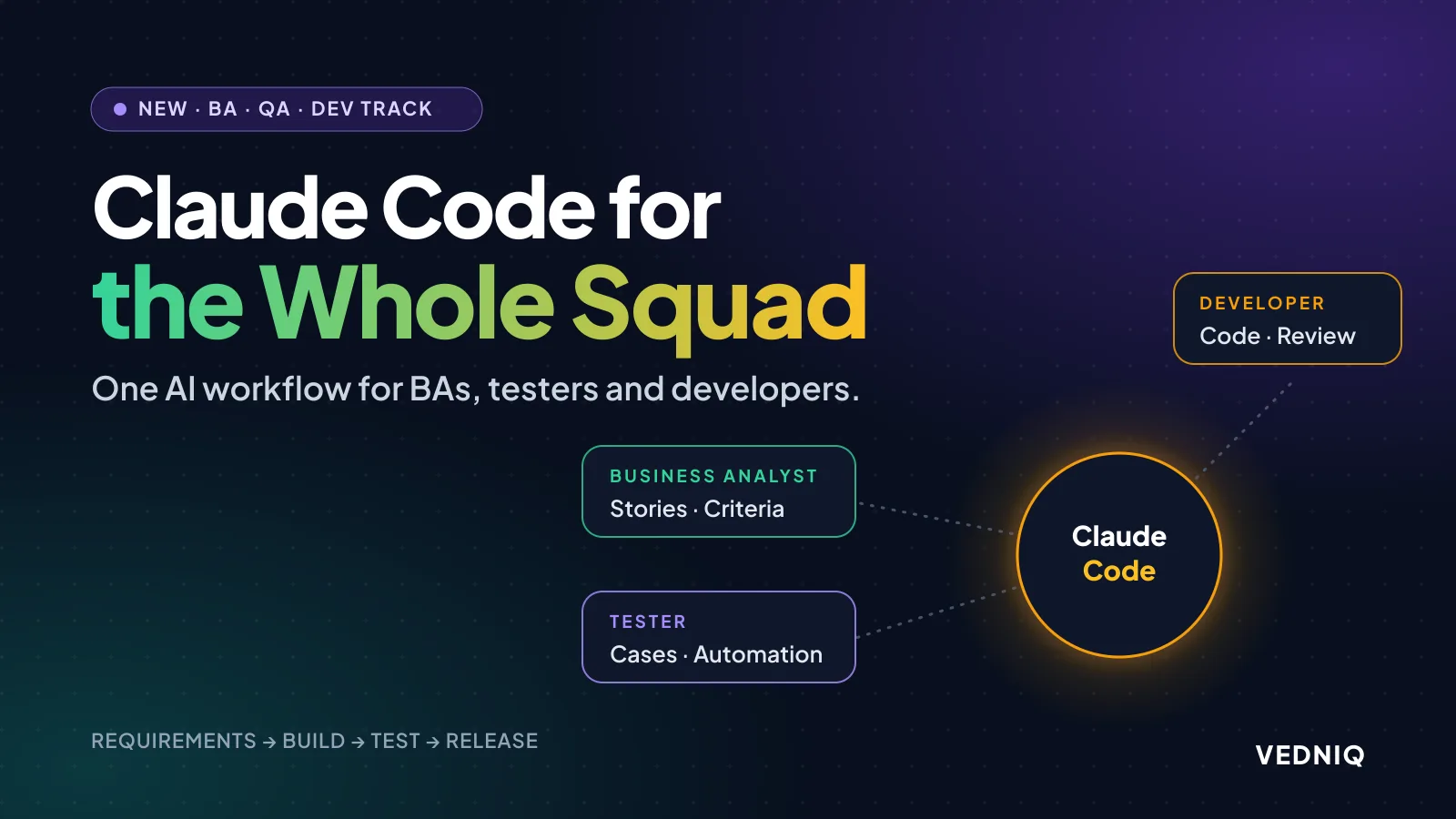
Requirements, tests and code stop living in three silos. BAs write specs Claude can use, testers generate BDD cases and automation from them, and developers implement against the same source of truth.
Claude Code for Business Analysts, Testers & Developers is a 1-day, instructor-led VEDNIQ course that teaches delivery squads to work from one shared spec. BAs turn stakeholder input into executable specs, QA engineers generate BDD tests and automation from those specs, and developers implement and verify against them, all with governance, traceability and cost controls. It is delivered live, virtually or onsite, with four hands-on labs.
Last updated 1 October 2026 · Instructor: Lalit Jhawar
What are the key facts about this Claude Code course?
| Course | Claude Code for Business Analysts, Testers & Developers (Spec-Driven Development track) |
|---|---|
| Duration | 1 day, about 5.5 hours of instruction plus 4 labs |
| Format | Live instructor-led, virtual or onsite, cohort of your team |
| Audience | Business Analysts, QA engineers and SDETs, developers, delivery and QA leads |
| Prerequisites | Core Claude understanding and experience; working knowledge of requirements analysis (BA), test design or automation (QA), or software development (Dev) |
| You will build | A complete spec from a sample business requirement, BDD test cases and automated scripts generated from it, and a spec-aligned implementation, with a traceability audit |
| Assessment | Pre/post assessment, optional virtual proctoring, digital certificate |
| Level | Intermediate |
What changes when BAs, testers and developers share one spec?
| Siloed handoffs | Shared-spec squad with Claude Code | |
|---|---|---|
| Business Analyst | Requirement documents handed over and reinterpreted | Executable specs with AI-assisted gap and ambiguity checks |
| Tester | Tests written after build from a personal reading of the requirement | BDD cases and automation generated from the same spec |
| Developer | Implements an interpretation of the document | Implements and verifies against the shared spec |
| Traceability | Maintained by hand in spreadsheets | Requirement to spec to code to test to defect, audited |
| Change | Updates reach each role at different times | Versioned spec with AI-assisted impact analysis |
What will your team be able to do after this course?
BAs: specs, not documents
Go from stakeholder interviews to structured specs with acceptance criteria, and use AI to find gaps and ambiguity before build.
QA: tests from specs
Write Gherkin and given-when-then specs, then generate unit, integration and e2e tests with regression and risk-based selection.
Devs: build against the spec
Use Claude Code to implement from the shared spec and keep the code traceable to requirements and tests.
One traceable chain
Audit requirement to spec to implementation to test to defect linkage across the squad.
Connect your tools
Integrate Jira, Confluence, Azure DevOps, TestRail and Playwright or Selenium runners through MCP.
Govern what AI produces
Apply data masking, PII redaction, review calibration and sign-off before anything ships.
What does the 1-day curriculum cover?
Five modules and four hands-on labs. Open any module for the topic list.
M1Enterprise Adoption of Claude for BA, QA & Dev Teams60 min
- 1.1Scalable AI-assisted practices for BA, QA and engineering teams
- 1.2Governance: access control, audit trails, usage policies
- 1.3Guardrails: approval workflows, permission modes, sandboxing for test and requirements environments
- 1.4Deployment options at a glance: Claude.ai Enterprise, Claude Console and API, Claude Code CLI, Bedrock and Vertex
- 1.5Content and topic guardrails for sensitive test and business data
- 1.6Security and compliance: data handling and masking, PII redaction, log retention
- 1.7Rollout: pilot, team, org-wide; quality and requirement metrics; internal champion and support model
M2Spec-Driven Development Across the SDLC120 min
- 2.1What spec-driven development is and why it matters across the SDLC
- 2.2From requirements to executable specs: acceptance criteria, structure, edge cases
- 2.3Traceability: spec to design and test plan to implementation and test cases
- 2.4BACollaborative spec authoring with AI, from stakeholder interviews to draft specs
- 2.5BAGap and ambiguity detection in requirements using AI
- 2.6QAWriting specs AI can generate tests against: Gherkin, BDD, given-when-then
- 2.7QAAutomated test generation from specs: unit, integration, e2e; regression and risk-based selection
- 2.8DEVImplementing from the shared spec with Claude Code: plan mode, small diffs, tests first, review
- 2.9Claude Skills and hooks for BA, QA and Dev workflows: spec templates, review checklists, test-generation skills
- 2.10MCP integrations with enterprise tooling: Confluence, Jira, Azure DevOps, TestRail, Playwright and Selenium runners
- 2.11Security review as a gate: keeping confidential data out of prompts and logs
M3AI Fluency and the 4D Framework30 min
- 3.1Overview for BA, QA and Dev teams
- 3.2Delegation: what to hand off to AI versus keep manual
- 3.3Description: writing effective prompts for requirements elicitation and test scenarios
- 3.4Discernment: validating AI-generated specs, tests and code
- 3.5Diligence: stakeholder sign-off, edge-case verification and business intent
M4Evaluating & Governing AI-Generated Artifacts65 min
- 4.1Review calibration: clarity, completeness and testability for specs; correctness and coverage for tests and code
- 4.2Traceability audits: requirement to spec to implementation to test to defect
- 4.3Change management: versioning specs and AI-assisted impact analysis
- 4.4QACoverage analysis: gaps, redundancy, flaky-test detection
- 4.5Metrics: requirement defect rate, defect escape rate, cycle time, generation velocity, stakeholder satisfaction
- 4.6Case examples: before and after SDD adoption
M5Model Selection, Cost & Context Optimization55 min
- 5.1Model selection framework: Haiku, Sonnet and Opus fit for spec, test and code tasks
- 5.2Context window management for large requirement sets, specs and test suites
- 5.3Prompt caching: mechanics and cost impact for repetitive spec and test contexts
- 5.4Cost and usage monitoring: Claude Console dashboards and budgets
- 5.5Model lifecycle: migrating spec and test-generation prompts across Claude generations
Who should attend this Claude Code course for BAs, testers and developers?
Delivery squads that want requirements, tests and code to stay aligned: Business Analysts and product owners, QA engineers and SDETs, developers, and the delivery or QA leads who manage them. Items are tagged BA, QA or DEV so each role knows which labs are theirs; everyone shares the same spec and the same traceability chain.
Engineering leads wanting the deep dive on the harness, Spec Kit loop and Bedrock? See Claude Code: SDD.
Who will teach this Claude Code course?

Lalit Jhawar
Founder of VEDNIQ, with 8+ years of enterprise training experience across AWS, Generative AI and data engineering, and 50,000+ professionals trained. Read the full profile.
Where is Claude Code training available in India?
Onsite training is available across Mumbai, Delhi NCR, Bangalore, Hyderabad, Pune, Chennai, Kolkata, Ahmedabad and Jaipur. Virtual instructor-led training is available pan-India and internationally. Cohorts of 5 to 500+ professionals, with labs tailored to your stack.
Questions about this Claude Code course
Is Claude Code useful for Business Analysts and non-developers?
Yes. BAs use Claude to turn stakeholder interviews into structured specs, detect gaps and ambiguity, and keep requirements versioned. The course is hands-on and role-tagged, so BAs focus on spec authoring and review rather than writing code.
How do testers use Claude Code?
QA engineers write Gherkin and given-when-then specs, then use Claude Code to generate BDD test cases and automated scripts, plan regression and risk-based selection, and analyse coverage gaps and flaky tests. MCP connections can link runners such as Playwright or Selenium.
What do developers get from a course shared with BAs and testers?
Developers implement against the same spec the BAs and testers use, so requirements, code and tests stay traceable. They also learn the review calibration and governance that keep AI-generated code safe to merge.
How long is the course and how is it delivered?
One day of live, instructor-led training, about 5.5 hours of instruction plus four hands-on labs, delivered virtually or onsite for your team.
What are the prerequisites?
Core Claude understanding and experience, plus working knowledge of requirements analysis (BA), test design or automation (QA), or software development (Dev).
Which tools does the course cover?
Claude.ai Enterprise, Claude Console and API, and Claude Code, with MCP integrations for Confluence, Jira, Azure DevOps, TestRail and Playwright or Selenium runners. Bedrock and Vertex are covered at a glance. We can adapt labs to the tools your team uses.
How is this different from the Claude Code: SDD course?
Claude Code: SDD is engineering-focused and goes deep on the Claude Code harness, Spec Kit workflow and AWS deployment. This course is role-based: it spans BA, QA and Dev with shared specs and a traceability chain. Teams often run both.
Is there an assessment and certificate?
Pre and post assessments are available, with optional virtual proctoring and a digital certificate for participants who pass.
Can Claude Code generate BDD feature files and step definitions?
Yes. Given a spec with acceptance criteria, Claude Code can draft Gherkin feature files and matching step definitions or automation scripts for frameworks such as Playwright or Selenium. Your testers review and refine the output, which is exactly what the QA labs practise.
Is Claude Code training available in India?
Yes. VEDNIQ is based in Maharashtra, India. Onsite training is available across Mumbai, Delhi NCR, Bangalore, Hyderabad, Pune, Chennai, Kolkata, Ahmedabad and Jaipur. Virtual instructor-led training is available pan-India and internationally.
Sources and further reading
Primary sources for the tools and methods taught in this course.
- Claude Code overview · Anthropic documentation
- CLAUDE.md and memory · Anthropic documentation
- Model Context Protocol (MCP) in Claude Code · Anthropic documentation
- Claude Academy: Claude Code 101 · Anthropic, free self-paced course
- What is spec-driven development? · Spec Kit documentation
- Spec-driven development, Technology Radar · Thoughtworks