Claude Code: SDD
Spec-Driven Development Training for engineering teams
Stop vibe coding. Learn to write specs that Claude Code can execute, then drive it from spec to plan, tasks, code and tests with guardrails your security team will sign off.
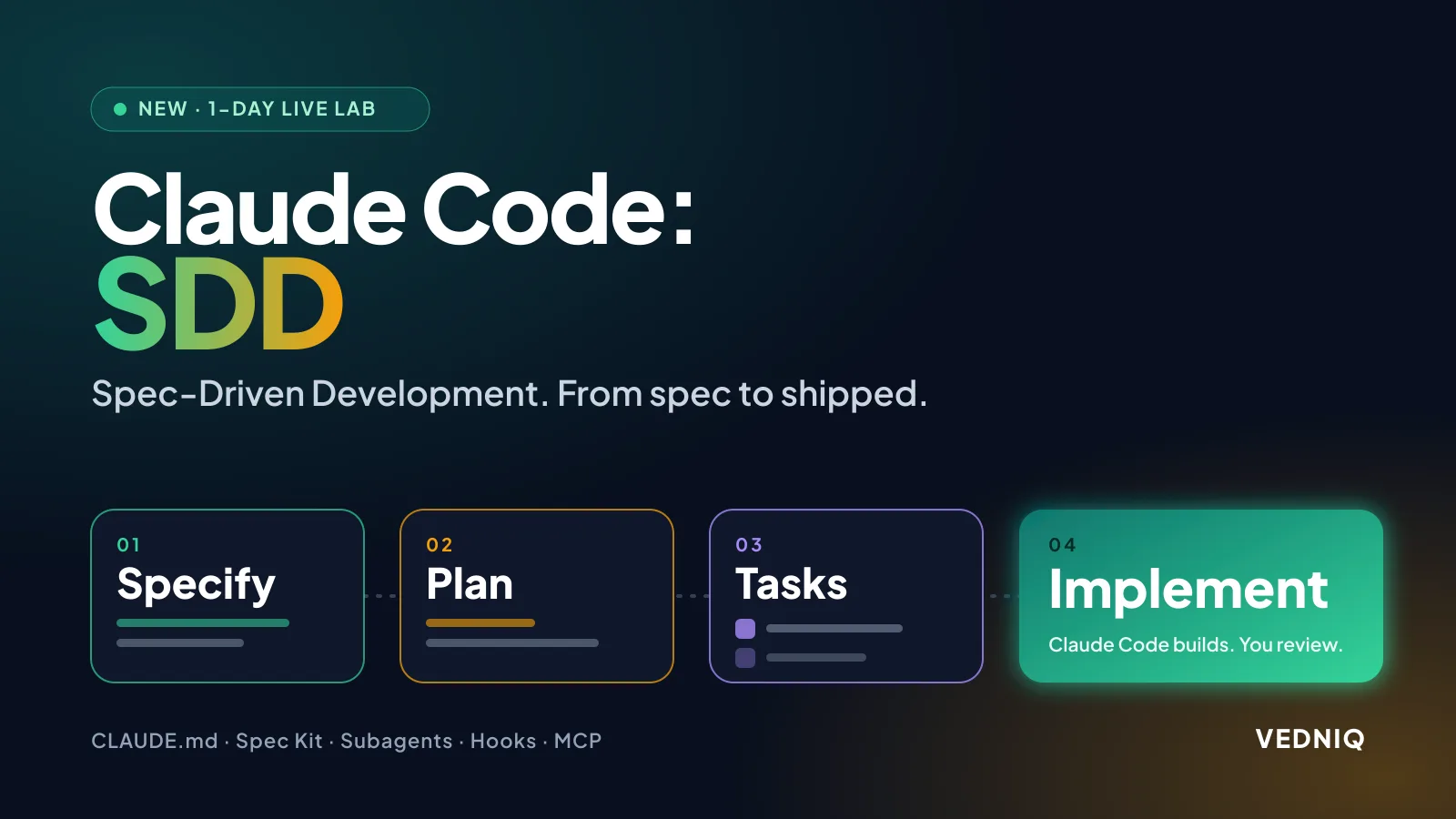
Claude Code: SDD is a 1-day, instructor-led VEDNIQ course on spec-driven development with Claude Code. Engineering teams learn to write executable specs, configure the Claude Code harness (CLAUDE.md, skills, hooks, MCP), run the spec, plan, tasks and implement loop, and govern AI-generated code with traceability, review calibration and cost controls. It is delivered live, virtually or onsite, with four hands-on labs.
Last updated 1 October 2026 · Instructor: Lalit Jhawar
What are the key facts about this Claude Code course?
| Course | Claude Code: SDD (Spec-Driven Development) |
|---|---|
| Duration | 1 day, about 5.5 hours of instruction plus 4 labs |
| Format | Live instructor-led, virtual or onsite, cohort of your team |
| Audience | Software engineers, tech leads, architects, engineering managers |
| Prerequisites | Core Claude understanding and experience; working knowledge of Git and one programming language; basic AWS familiarity helpful for the Bedrock lab |
| You will build | A spec-to-implementation-to-test pipeline for a sample feature, a custom Skill with a policy-enforcing hook, and a cost-optimised Bedrock-backed session |
| Assessment | Pre/post assessment, optional virtual proctoring, digital certificate |
| Level | Intermediate to advanced |
How is spec-driven development different from vibe coding?
| Prompt-only (vibe) coding | Spec-driven development with Claude Code | |
|---|---|---|
| Source of truth | Chat history and the generated code | A written spec with acceptance criteria |
| Starting point | A prompt | A spec, clarified before any code is written |
| Review | Read the diff and hope it matches intent | Check output against the spec and tests |
| Traceability | Low: intent lives in a chat | Spec to plan to tasks to code to tests |
| Team use | Individual, hard to repeat | Shared artifacts anyone can review and rerun |
| Typical failure | Plausible code that solves the wrong problem | Ambiguity caught in the spec, not in production |
What will your team be able to do after this course?
Write specs AI can execute
Turn intent into structured specs with acceptance criteria, edge cases and clarifications that leave Claude Code nothing to guess.
Run the full SDD loop
Move through constitution, specify, clarify, plan, tasks, analyze and implement, with review gates at every step.
Engineer the Claude Code harness
Configure CLAUDE.md, reusable Skills, hooks, custom slash commands and MCP integrations for your SDLC.
Govern AI-generated code
Apply permission modes, security review gates, traceability audits and review calibration before merge.
Control cost and context
Choose the right model, manage context, and use prompt caching to cut token spend.
Roll out across the org
Plan pilot, team and org-wide adoption with metrics and an internal champion model.
What does the 1-day curriculum cover?
Five modules and four hands-on labs. Open any module for the topic list.
M1Engineering the Claude Code Harness100 min
- 1.1Configuring the agent operating environment
- 1.2Rules, project constitution and CLAUDE.md
- 1.3Reusable Skills: structure, packaging, discovery
- 1.4Hooks: lifecycle events, automation and enforcement
- 1.5Custom slash commands
- 1.6MCP integrations with enterprise SDLC tooling
- 1.7Security review as a gate: automated review before merge, keeping secrets out of prompts and logs
- 1.8When to fan out: subagents and multi-agent patterns versus a single agent
M2Spec-Driven Development with AI100 min
- 2.1Why spec-first matters with AI-assisted engineering, and where vibe coding breaks down
- 2.2Writing specs AI can execute against: user stories, acceptance criteria, edge cases, open questions
- 2.3The SDD loop with Claude Code and GitHub Spec Kit: constitution, specify, clarify, plan, tasks, analyze, implement
- 2.4Traceability: spec to implementation to tests
- 2.5Evaluating AI-generated output: code review calibration, lightweight eval and regression checks
- 2.6Brownfield SDD: adding specs to an existing codebase and detecting spec-code drift
- 2.7Quality and delivery outcomes: before and after case examples
M3AI Fluency and the 4D Framework30 min
- 3.1Overview for engineering teams
- 3.2Delegation: what to hand to Claude Code and what to keep
- 3.3Description: prompts and specs that state intent, constraints and done
- 3.4Discernment: judging AI output on correctness, security and fit
- 3.5Diligence: accountability, review and sign-off
M4Enterprise Adoption, Governance and Deployment65 min
- 4.1Scalable development practices for teams and organisations
- 4.2Governance: access control, audit trails, usage policies
- 4.3Guardrails: approval workflows, permission modes, sandboxing
- 4.4AWS Bedrock deployment patterns: cross-region inference, provisioned throughput versus on-demand, VPC and PrivateLink
- 4.5Bedrock Guardrails and enterprise content policy
- 4.6Security and compliance: data residency, log retention, secrets and credentials in agent workflows
- 4.7Rollout: pilot, team, org-wide; productivity metrics; internal champion and support model
M5Cost, Model and Context Optimization60 min
- 5.1Model selection framework: Haiku, Sonnet and Opus fit
- 5.2Context window management strategies
- 5.3Token-efficiency practices
- 5.4Prompt caching on Bedrock: mechanics and cost impact
- 5.5Cost monitoring: dashboards, budgets and alarms
- 5.6Scaling beyond the local harness: AgentCore Runtime and observability with CloudWatch and X-Ray
- 5.7Model lifecycle: migrating between Claude generations without breaking prompts and hooks
Who should attend Claude Code: SDD?
Engineering teams that already use AI assistants and want predictable, reviewable output instead of one-off prompts: software engineers, tech leads, architects and engineering managers. If your Business Analysts and Testers will join the same programme, pair it with the role-based course below.
Business Analysts and Testers on the same programme? Pair this with Claude Code for Business Analysts, Testers & Developers.
Who will teach this Claude Code course?

Lalit Jhawar
Founder of VEDNIQ, with 8+ years of enterprise training experience across AWS, Generative AI and data engineering, and 50,000+ professionals trained. Read the full profile.
Where is Claude Code training available in India?
Onsite training is available across Mumbai, Delhi NCR, Bangalore, Hyderabad, Pune, Chennai, Kolkata, Ahmedabad and Jaipur. Virtual instructor-led training is available pan-India and internationally. Cohorts of 5 to 500+ professionals, with labs tailored to your stack.
Questions about this Claude Code course
What is spec-driven development (SDD) with Claude Code?
Spec-driven development makes a written specification the source of truth. You describe intent, acceptance criteria and constraints first, then Claude Code plans, breaks down tasks, implements and tests against that spec. It replaces ad hoc prompting with a reviewable, traceable workflow.
Who is Claude Code: SDD for?
Software engineers, tech leads, architects and engineering managers who use or are about to adopt Claude Code. Core Claude experience, Git and one programming language are expected. Business Analysts and Testers have a dedicated course.
How long is the course and how is it delivered?
One day of live, instructor-led training, about 5.5 hours of instruction plus four hands-on labs. It runs virtually or onsite for your team, and the content can be adapted to your repo and tooling.
Does the course use GitHub Spec Kit?
Yes. The SDD loop is taught with Claude Code and GitHub Spec Kit commands (constitution, specify, clarify, plan, tasks, analyze, implement). The principles apply to any spec workflow, so you can adapt them to your own templates.
Do we need AWS Bedrock to attend?
No for the SDD and harness modules. The enterprise deployment and cost modules use AWS Bedrock as the reference environment, and the same governance and cost principles apply to Claude Console or Vertex AI setups. Tell us your platform when you request a quote.
What are the prerequisites?
Core Claude understanding and experience, working knowledge of Git and one programming language, and basic AWS familiarity if you want to complete the Bedrock lab.
Can the training be customised to our codebase?
Yes. VEDNIQ tailors labs to your stack, repo conventions and compliance needs. Share your tooling and governance requirements on the demo request.
Is there an assessment and certificate?
Pre and post assessments are available, with optional virtual proctoring and a digital certificate for participants who pass.
What is the difference between spec-driven development and vibe coding?
Vibe coding steers an AI assistant with ad hoc prompts and judges the result by reading code. Spec-driven development writes the intent, acceptance criteria and constraints down first, then has the AI plan, implement and test against that spec, so output can be reviewed against something explicit.
How is Claude Code different from GitHub Copilot?
Per Anthropic's documentation, Claude Code is an agentic coding tool that reads your codebase, edits files and runs commands across the terminal, IDEs, desktop and web. Copilot is a different product with its own strengths, and many teams use both. This course teaches the spec-driven workflow and governance, not a tool comparison; tell us which tools you run and we will tailor the labs.
Is Claude Code training available in India?
Yes. VEDNIQ is based in Maharashtra, India. Onsite training is available across Mumbai, Delhi NCR, Bangalore, Hyderabad, Pune, Chennai, Kolkata, Ahmedabad and Jaipur. Virtual instructor-led training is available pan-India and internationally.
Sources and further reading
Primary sources for the tools and methods taught in this course.
- Claude Code overview · Anthropic documentation
- CLAUDE.md and memory · Anthropic documentation
- Hooks · Anthropic documentation
- Skills · Anthropic documentation
- Model Context Protocol (MCP) in Claude Code · Anthropic documentation
- GitHub Spec Kit · GitHub, open-source toolkit for spec-driven development
- What is spec-driven development? · Spec Kit documentation
- Spec-driven development, Technology Radar · Thoughtworks